System Requirements
Cortex is a lightweight application. Its system requirements are mainly driven by the size of your database - the larger the database, the more powerful your SQL Server and application server should be.
Deployment Overview
A typical Cortex deployment consists of three layers: an application server running Cortex on IIS, one or more SQL Server instances holding your data, and an authentication service for user login.
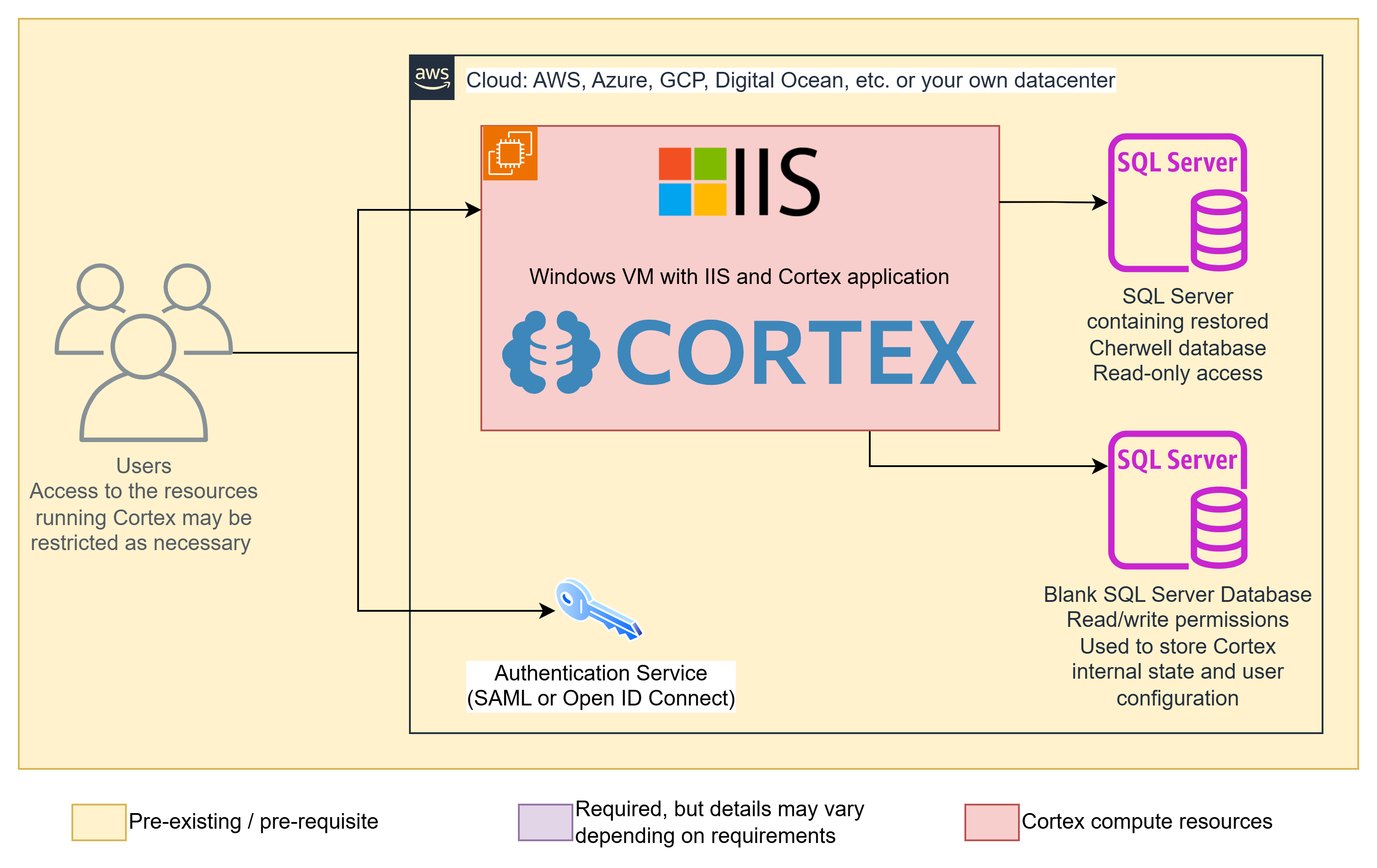
Application server - A Windows VM running IIS with the Cortex application installed. This can be hosted anywhere: AWS, Azure, GCP, Digital Ocean, your own datacenter, or any other environment that can run Windows Server. User access to the VM itself can be restricted as needed.
SQL Server (archive data) - Contains the restored database from your source system (such as Cherwell). Cortex connects to this with read-only credentials and never writes to it.
SQL Server (Cortex database) - A separate blank SQL Server database used to store Cortex's internal state and user configuration. Cortex requires read/write access to this database. This can be on the same SQL Server instance as your archive data or a separate one.
Authentication service - Cortex supports SAML and OpenID Connect for user login. Your existing identity provider (such as Azure AD / Entra ID, Okta, ADFS, or Google Workspace) handles authentication. See Authentication for supported options.
The application server and SQL Server can run on the same machine - this is fine for a demo or evaluation environment. For production, we recommend separate machines. SQL Server tends to consume most of the available memory and CPU, which can starve the Cortex application running alongside it.
SQL Server
Supported versions: SQL Server 2016, 2017, 2019, 2022, and 2025.
We test against the versions listed above. As new SQL Server versions are released and verified, we add them to this list - if you are planning to use a version not listed here, check with us first.
- Use the same version of SQL Server your source database was running on when possible.
- Follow SQL Server's recommended specs for memory and CPU based on your database size.
- Ensure there is enough disk space for the OS, SQL Server, and your full database.
- Full-Text Search must be enabled during SQL Server installation.
- Both SQL Server authentication and Windows authentication are supported.
- The archive (source) database connection requires read-only access only. See SQL Server Security Setup for recommended configurations.
Sizing and Availability
- The Cortex database is small — typically well under 1 GB. It stores only Cortex's own configuration and settings.
- The archive database is separate and much larger — it holds your source system's data (Cherwell, ServiceNow, ManageEngine, etc.). It is normally the customer's existing SQL Server hosting that data, or a restored copy of it. Size your SQL Server hardware around the archive database, not the Cortex database.
- Cortex keeps two independent connections: a read/write connection to the Cortex database and a read-only connection to each archive database. See How Cortex Archives Work.
- High availability — the archive database(s) may reside in a SQL Server high-availability cluster (for example a failover cluster instance or an Always On availability group); this is supported.
- Failover behavior — during a database failover, Cortex does not automatically retry every failed connection attempt. Users may see a brief error on screen if a query times out or fails; refreshing the page re-establishes the connection.
Application Server
- Windows Server 2019 or later
- Minimum 4 GB RAM and 2 CPUs (increase based on load and database size)
- IIS with WebSockets support enabled
- No .NET runtime installation required - it is bundled with Cortex
Clients
- All modern browsers on all modern operating systems are supported.
- Cortex is not mobile-optimized but does function on mobile devices.
Next step
Continue to: Install